



Chair File: Leadership Dialogue — Insights and Innovation in Rural Hospitals with Mark Boucot of Potomac Valley Hospital
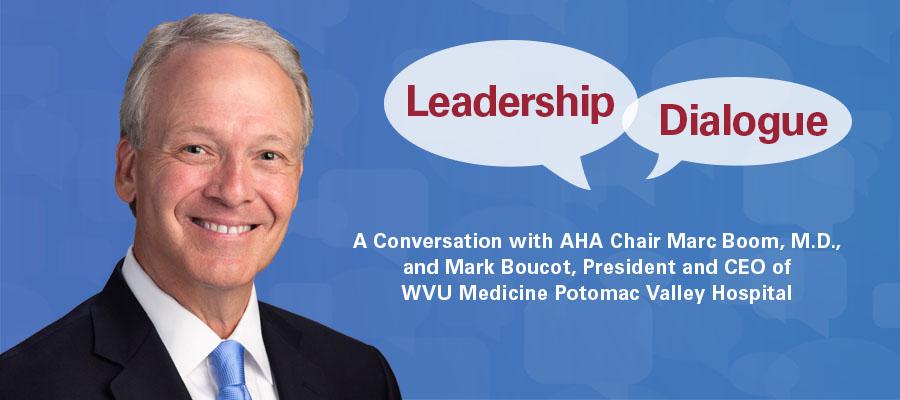
Leaders of rural hospitals face similar challenges as leaders of urban hospitals, but with an added degree of complexity, including recruiting staff, navigating administrative and reimbursement constraints, and more.
In this Leadership Dialogue, I’m joined by Mark Boucot, president and CEO of Potomac Valley Hospital, a 25-bed critical access hospital that is part of WVU Medicine. Potomac Valley Hospital is the recipient of the inaugural AHA Rural Hospital Excellence in Innovation Award, which I presented to Mark at AHA’s Rural Health Care Leadership Conference in early February.
Mark and I discuss how Potomac Valley Hospital is developing innovative ways to expand access to local care for patients. Mark describes the hospital’s virtual ICU, which provides full access to lifesaving care within the PVH facility and the patient’s home community. He also shares what makes him optimistic for the future of health care.
I hope you find these conversations interesting and insightful. Look for them once a month as part of the Chair File in 2026.
View Transcript
00:00:00:02 - 00:00:23:02
Tom Haederle
Welcome to Advancing Health. In February's Leadership Dialogue podcast, Dr. Marc Boom, president and CEO of Houston Methodist and the 2026 Board chair of the American Hospital Association, speaks with a top rural health care leader about how creativity and excellence can address the unique challenges facing rural providers.
00:00:23:05 - 00:00:44:06
Marc Boom, M.D.
Well, greetings and thank you, everybody for joining me today. I'm Marc Boom. I'm the president and CEO of Houston Methodist, and I'm excited to be the chair of the, American Hospital Association this year. As I mentioned during my first leadership dialog in January, I believe innovation is just a critically important part of ensuring that patient care is absolutely unparalleled.
00:00:44:09 - 00:01:09:02
Marc Boom, M.D.
So my plan to hopefully weave innovation as a theme throughout each of these discussions. And so today we're doing exactly that again, but this time through the lens of a rural hospital leader. I know that all of our colleagues, whether they're leaders of big health systems or small independent hospitals, are committed to innovating to deliver the best possible care to the people they serve and also navigating big changes and challenges in our field.
00:01:09:04 - 00:01:42:03
Marc Boom, M.D.
And we know that when it comes to challenges, the leaders of our rural hospitals, frankly, have a whole extra degree of complexity. I mean, recruiting staff. The administrative and reimbursement challenges, transportation, just to name a few. And I know I'm anticipating our guest today will share that amidst those challenges, many opportunities for growth and innovation. You know, just, two weeks ago, I attended the AHA's Rural Health Care Leadership Conference, and I was totally energized by the sessions and the discussions that were there on building innovative approaches to transformative care delivery.
00:01:42:05 - 00:02:11:15
Marc Boom, M.D.
So today, we have as our guest, Mark Boucot. Mark is the president and chief executive officer of Potomac Valley Hospital in Kaiser, West Virginia. He attended the conference as well. I met and chatted with him there because he was the recipient of the AHA’s Rural Hospital Excellence in Innovation Award. That's an award that recognizes rural hospitals that demonstrate responsiveness, creativity, and excellence in developing or sustaining programs that address the unique challenges that face rural and frontier communities.
00:02:11:15 - 00:02:14:26
Marc Boom, M.D.
So, Mark, welcome today. I'm glad to have you here.
00:02:14:29 - 00:02:17:17
Mark Boucot
Well, thank you for having me. I'm honored to be here.
00:02:17:20 - 00:02:35:24
Marc Boom, M.D.
And we'll keep it nice and confusing with two Marks today. And maybe we'll pronounce them slightly differently. Mine's with the C, yours is with a K, but it is great to have a fellow Mark here for our podcast today. So I want to dive right in. And first off, I know Potomac Valley Hospital, which you lead, is part of WVU medicine.
00:02:35:27 - 00:02:45:03
Marc Boom, M.D.
Which, if I'm not mistaken, you are a 25 bed critical access hospital. So let me start. Tell me a little bit more about the hospital and the community you serve.
00:02:45:03 - 00:03:11:18
Mark Boucot
Yeah that's correct. We're a 25 bed, critical access hospital. Although you'd be very surprised about the amazing array of services that we provide there. The hospital, basically has, general surgery, orthopedics, very strong orthopedics program, along with multiple specialty services. We opened a hematology oncology center there in our geography to serve the patients that we were blessed to take care of.
00:03:11:21 - 00:03:36:28
Mark Boucot
We have, urology. We have along with that. We have colorectal surgery, we have pain management. So there's a there's a pretty vast array of services. We serve a market area of really I think it's a three county area that that comes to the hospital, our community near Potomac Valley Hospital, about 50,000 residents. But we serve a much broader area.
00:03:36:28 - 00:04:06:07
Mark Boucot
People come from about an hour away. And really, I think one of the things that I for me, that is a hallmark of our organization is, is that we have adopted a mission statement that we care for every patient like we would our own family. And so with that as our Northstar, we are able to innovate and develop patient care services for our community, always knowing that we're going to care for them, we're going to include them, we're going to incorporate their needs
00:04:06:07 - 00:04:09:18
Mark Boucot
most importantly, because everything that we do is for them.
00:04:09:20 - 00:04:31:19
Marc Boom, M.D.
I'd love to hear about your technology journey. We believe, and that's why I'm weaving this in these series that, you know, innovating through technology can really transform innovation. And when you talk about that Northstar, which I love of it's all about the patients, right? That's why we're all in health care. I assume when you're looking at technology as a critical access hospital, it's all about the patient, how you do that.
00:04:31:19 - 00:04:39:11
Marc Boom, M.D.
So how do you think about, technology solutions, the infrastructure improvements, care management, all of the above, in that setting?
00:04:39:13 - 00:05:10:16
Mark Boucot
Yeah. Like most organizations, we have a pretty strong governance infrastructure around the development of our technology services. We're blessed to be part of WVU medicine. And because of that, we are able to have advancements in technology that many small organizations that are independent or standalone don't get the opportunity to have. But we've integrated AI into our physician practices and it's one of the most amazing things for them because they're direct face to face care now is much different.
00:05:10:23 - 00:05:33:26
Mark Boucot
So we're serving the patient more than the computer, in that environment. And as we build and grow, we think our way through and develop strategies that would enable us to really provide the academic medical center level of care at our small hospital. And I think that that has been a hallmark of how we decide what we're going to do and how we're going to move forward.
00:05:33:28 - 00:05:55:07
Marc Boom, M.D.
And we'll pull that thread a little bit. So you say, as part of WVU medicine, we have many critical access hospitals out there, as you alluded to, that are standalone on their own. I'm sure you think about that. I know there's pros, I know there's cons, but how would you approach that if you didn't have the WVU medicine as that, as that kind of feeder of some of those technologies?
00:05:55:09 - 00:06:24:28
Mark Boucot
A great example is this program that we were recognized for with the virtual ICU program. Very low cost infrastructure, just with some very simple tablets. We implemented a virtual ICU program where we were able to care for patients. We partnered with a large organization, which is Ruby Memorial, part of our own health system. But you could do that with any other academic medical center that you work with.
00:06:25:00 - 00:06:56:21
Mark Boucot
And basically what we do is we created a partnership where they can monitor our patients. The surgical intensivist in their ICU and critical care intensivist can care for our patients through just a very simple virtual hook up. This, this infrastructure actually, I think cost about $5,400 to implement. So it doesn't have to be rocket science. And it doesn't always have to be complicated in order to be successful.
00:06:56:26 - 00:07:21:12
Mark Boucot
I would also say for me, I've been the independent organization, and we had to make some decisions about making sure that what we provide is as close to the state of the art as we can possibly get. And even so, I would say the most important thing for us is that nothing is going to take away from the face to face care for the patients with our providers.
00:07:21:15 - 00:07:42:14
Mark Boucot
And so we try to enable them to be able to to care. And so even with some when we had antiquated technology or antiquated IT systems, we still were able to utilize Dragon and other scribing techniques that would try to keep the providers as close to the bedside as possible.
00:07:42:17 - 00:08:00:03
Marc Boom, M.D.
So you have 25 beds. You described obviously a lot of very key specialists and talented people there. In those 25, in any given time, how many people are in the ICU? I'm just trying to parse out a little bit more how you know, what you won the award for and exactly what you're doing so it can inspire some others.
00:08:00:05 - 00:08:21:09
Mark Boucot
When I started there, the ICU was closed and all of the equipment was draped with towels or sheets. Basically, the light hadn't been turned on for about 18 months leading up to this. I think we just decided that no matter what, this ICU needs to be open, it needs to be open for this community. And so we're going to figure out a way to make it work.
00:08:21:11 - 00:08:45:15
Mark Boucot
And, we took this pilot program to the health system and said, look, you know, hey, if we're able to partner with you, what that will also help us do is keep our patients local so that we don't have to transfer as many patients out, which would help the health system with overcrowding and very high centers, which is what we are all living through today.
00:08:45:18 - 00:09:10:16
Mark Boucot
We opened up the ICU. Basically, we had to make some investments in equipment, new IV pumps, made sure the beds, everything was working properly. And once we implemented the virtual ICU program with the health system, we found that it created an environment where the hospitalist felt much more safe and secure and supported to be able to admit more patients.
00:09:10:16 - 00:09:22:21
Mark Boucot
And therefore, it drove the census up quite a bit. So when we started, there was an ADC average daily census of two patients who were in the hospital on my first day and in
00:09:22:22 - 00:09:24:21
Marc Boom, M.D.
Hospital overall or in the ICU?
00:09:24:24 - 00:09:26:02
Mark Boucot
Yes, in the entire 25 bed hospital..
00:09:26:02 - 00:09:28:04
Marc Boom, M.D.
Okay. Yeah, that's a small
00:09:28:07 - 00:09:56:14
Mark Boucot
Yeah, there was it was pretty empty. And so now I would say a good 70 to 80 days a year we're at 100% occupancy. The ICU is always full now at this point. And, you know, we combined this implementation for virtual ICU, which is different than an EICU. And we combined it with a pretty rigorous performance improvement in our emergency department.
00:09:56:16 - 00:10:16:25
Mark Boucot
We've got our door to doc time down around ten minutes. And we've got our door to bed time within like four minutes. So basically when you come in, you register, you go right to a bed. And so that requires a pretty significant community of people that are working together to make sure that the rooms are turning over fast.
00:10:16:27 - 00:10:41:29
Mark Boucot
And we went from about 12,000 visits in the emergency department a year, five years ago. We're up now around 22,000 visits in that same emergency department. So obviously we're expanding. We're investing in the community and growing and developing. But we had to create the service that people wanted. And people do want convenience. They want they don't want long wait times in the emergency department.
00:10:42:00 - 00:10:55:26
Mark Boucot
I think that combined with the virtual ICU, meaning that they would then be admissions in a way to create the admissions into the facility, those two things combined were pretty significant change initiatives.
00:10:55:28 - 00:11:03:01
Marc Boom, M.D.
So you must have gotten really positive feedback from the community, I would imagine, in terms of that ability to stay local.
00:11:03:03 - 00:11:37:23
Mark Boucot
Oh my goodness. Yes. The community is rallied around the hospital. When we have events, we just had a ribbon cutting for a new building. Honestly, it was standing room only. The community has been wonderful and I think every like every community, our community just desire to have a great hospital and one that they could rely on. And I think that this program and our service and our] caring toward really wanting to just do the right thing and always be that that organization that would care for every patient, like your own family.
00:11:37:25 - 00:12:09:03
Mark Boucot
That is our North Star. So those things resonate with people. They resonate with the employees that work here and our reputation built. I didn't have to do a lot of advertising. It really happened by word of mouth, just by the fact that we were a different organization. And it's funny, Mark, I'll tell you, one of the things that was really interesting is just renovating and putting in new flooring and painting walls and making the place look different also created a lot of excitement in the community that they knew a new day was coming.
00:12:09:06 - 00:12:13:17
Mark Boucot
There was going to be care and investment back in the local hospital.
00:12:13:19 - 00:12:38:17
Marc Boom, M.D.
So this is really a win for everybody. The community loves it. The patients get really top notch care. The doctors there feel more comfortable taking care of somebody sicker, knowing they have probably pretty immediate back up to make decisions and manage critical patients. And it decompresses some of the referral center that. So when you do have somebody you need to move or other places need to move somebody because they still need that referral center, it's more likely to get them in there, I suspect.
00:12:38:17 - 00:12:41:05
Marc Boom, M.D.
So it's been a it's been a win on all rounds.
00:12:41:07 - 00:13:01:26
Mark Boucot
It's a win win all the way around. And I'll tell you, one of the one of the unique things is, is that our physicians, who were the hospitalist team, once they really started admitting patients and they started to feel more secure by having that safety net with a virtual ICU, because if the patient ever then decompensated, they could just go right into the virtual ICU.
00:13:01:26 - 00:13:25:04
Mark Boucot
They'd get additional help in a consult. Once that happened, it's interesting - there began to be mutual learning in both directions. And our health system is so awesome in that, there's a great deal of humility on both sides of our organizations that they actually learn some things from our hospitalists and our hospitals learned a lot from them.
00:13:25:04 - 00:13:34:15
Mark Boucot
So it was a great mutual learning opportunity and just a really wonderful partnership of working together in a really positive way.
00:13:34:17 - 00:13:52:18
Marc Boom, M.D.
Hospitals always, I think, are pillars in their community. But in a rural environment, when you have a hospital that the people can be proud of, I mean, they rally around and it's such a core part as an employer, as a caregiver, I mean, so critical to the United States that we have amazing rural hospitals like yours.
00:13:52:20 - 00:14:11:13
Mark Boucot
Oh, thank you for saying that. And I would say it's very important that we continue to support our rural hospitals and our local hospitals. This hospital, just by simply growing and having a Northstar of caring for patients and opening practices and bringing a lot of different specialists in. Again, that list I gave you is just a short list.
00:14:11:15 - 00:14:41:08
Mark Boucot
Those things are really important. Also for the economic engine of the community, this hospital created 300 jobs in the town of in Mineral County and in the town of Kaiser. So that we, you know, we have a bigger tax base. As an organization, we have come a long way. And I think this is an important part of the American Hospital Association with the work that the hospital association is doing to really help hospitals be strong and be healthy,
00:14:41:11 - 00:14:59:25
Mark Boucot
it's just amazing work. And like you said on the stage, it's God's work to make sure that we're caring for patients and that we're really doing the work that is healing and helping people. And so I've never actually worked a day in my life, to be honest with you, because I was doing what I was called to do in my life.
00:14:59:28 - 00:15:13:16
Marc Boom, M.D.
That's great. That's amazing. Well, you know, let me ask you this then, for the next aspiring rural hospital leader who wants to implement some of these, any lessons learned? And then what's next? I mean, where are you going next from an innovation standpoint?
00:15:13:18 - 00:15:33:21
Mark Boucot
Yeah. Thank you. I think from a lessons learned perspective, I think that one of the things that I would say for me is just making sure that I always approach things with an open heart and an open ear and an open mind, the way that I conceive things as a leader doesn't always mean that's the right way to do things.
00:15:33:23 - 00:15:58:27
Mark Boucot
We had some big lessons learned, I think, also around technology, what we expected for it to cost and what it had to be. No, actually, it didn't need to be like $1 million price tag on this. And we actually were able to implement this just by opening various portions of EPIC and then also utilizing simple tablets.
00:15:58:29 - 00:16:20:17
Mark Boucot
And I think that, you know, sometimes we think it's a much bigger obstacle to jump than it actually is. And I think once we believed we could do it, we could. There was nothing that could stop us. So I think as soon as we had the faith in ourselves and that we learned that we can do it.
00:16:20:20 - 00:16:46:10
Mark Boucot
We did do it and we did accomplish it. I think for our future, we're going to continue to grow the utilization of AI and to really try to keep the documentation work that's being done through AI and through a bridge. And the technology that we have today keeps that physicians much more happy and satisfied with their care, because they're really spending time with their patients now versus serving a computer.
00:16:46:13 - 00:16:57:19
Mark Boucot
I think that's been a wonderful thing for us. And I would say that making the investment in technology is really paramount to where to success in today's world.
00:16:57:21 - 00:17:15:15
Marc Boom, M.D.
You're working towards that NorthStar. You're seeing it as never working a day in your life. This is a very impressive program. I see 100% even more in detail now why you've won this award, and I think it's an inspiration in many other hospitals. So thank you for your time today. Thank you for your perspective and your commitment.
00:17:15:15 - 00:17:33:03
Marc Boom, M.D.
I really appreciate you being here. And as I close, I want to amplify a comment that I made at the Rural Conference. I was glad you were listening when you said the God's word part. And that's really we need to work together as hospital leaders to be defined not by the challenges we face, but instead by how we overcome them.
00:17:33:03 - 00:17:46:04
Marc Boom, M.D.
And that's precisely what you have done. And congratulations to you and you and your team. Thank you, everybody, for finding some time today to listen. We'll be back next month for another Leadership Dialog conversation. Thanks so much.
00:17:46:06 - 00:17:54:17
Tom Haederle
Thanks for listening to Advancing Health. Please subscribe and rate us five stars on Apple Podcasts, Spotify, or wherever you get your podcasts.