



Podcasts
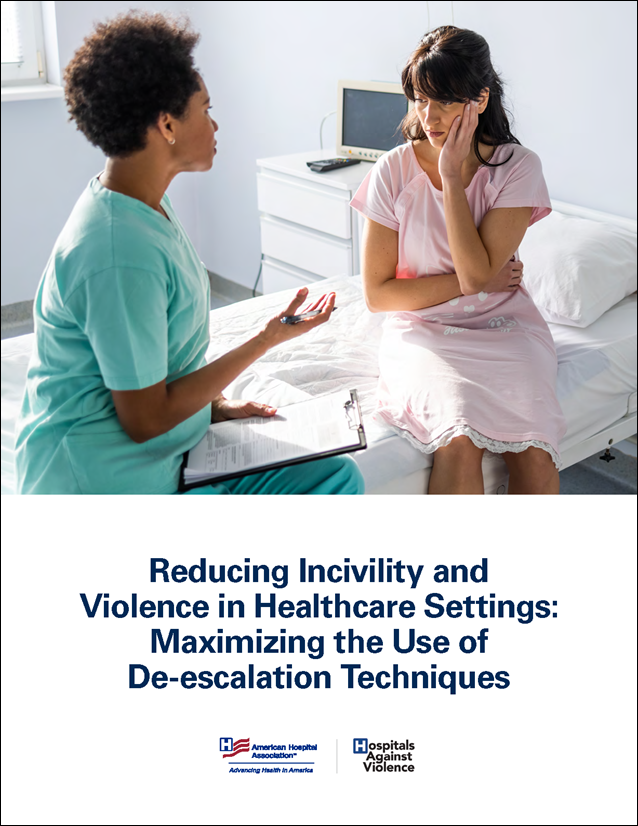
Issue-Brief: Reducing Incivility and Violence in Healthcare Settings: Maximizing the Use of De-escalation Techniques
Contents
- Introduction
- From Escalation to Stabilization: How De-escalation Improves Safety and Outcomes
- Training the Workforce: A Critical Prevention Strategy
- De-escalation Strategies in Practice: Prevention, Response and Recovery
- Key Considerations for Leaders Before Implementing a Behavioral Emergency Response Team
- Leadership Decision Points for De-escalation Implementation
- Additional Resources
View the detailed Issue Brief PDF.
This resource is intended as a supplement to existing clinical, training and documentation requirements, particularly those around the use of restraints and seclusion. All hospitals subject to the Medicare Conditions of Participation (CoPs) and all staff designated by a hospital as having direct patient care responsibilities (including contractors and agency personnel), as well as any other individuals designated by the hospital, must be trained and able to demonstrate competency in the application of restraints or implementation of seclusion. To satisfy this requirement, staff must also be trained in non-physical intervention skills, such as de-escalation techniques. More information about the Patient’s Rights CoP and its requirements may be found in the supplement. Readers are strongly encouraged to consult their compliance leaders to ensure their work is consistent with applicable federal and state laws and regulation.
Introduction
Hospitals and health systems are not immune from the rise of incivility and aggressive behaviors in communities across the U.S., creating an environment where it can be challenging to keep safety and compassion at the forefront. These aggressive feelings and behaviors don’t stop at the doors when patients and families come into the hospital. The consequences can be severe; verbal abuse and violence in healthcare settings make it more difficult to provide safe, high-quality care. A 2025 American Hospital Association report estimated that violence cost hospitals and health systems more than $18 billion in 2023 alone.1
Preventing violence in hospitals is a complex challenge that requires a comprehensive and multilayered approach. Effective violence prevention programs integrate strategies across the four domains of risk mitigation, violence intervention, culture of safety and workforce support, all of which play vital roles in creating safer care environments.2
One strategy that functions across these domains is deescalation, which involves recognizing early warning signs of distress, using communication techniques to calm emotions and creating an environment in which caregivers, patients and families feel safe and respected. Evidence-based de-escalation strategies are proven to reduce risk by providing all members of the healthcare workforce with the skills to safely manage escalating situations and maintain a therapeutic environment. De-escalation strategies can be seamlessly integrated into an existing workplace violence prevention program, supporting the workforce in confidently and compassionately responding to the needs of patients and families while improving safety for all.
This issue brief:
- Provides evidence for the benefits of integrating de-escalation strategies into an organization’s overall workplace violence prevention program.
- Offers suggestions for training the workforce in de-escalation strategies and tactics.
- Describes process and outcome metrics that can be used to measure the impact of de-escalation training.
- Outlines what strategies may look like in practice and shares examples from AHA member hospitals and health systems that are successfully implementing de-escalation tactics.
- Explores the benefits and potential challenges of implementing a Behavioral Emergency Response Team (BERT).
- Guides hospital and health system leaders through key considerations for implementing evidence-based de-escalation training opportunities at their organizations.
Developed with input from the AHA Committee on Behavioral Health and the Hospital Against Violence Advisory Group, this resource reflects successful practices from leaders across AHA member hospitals and health systems.
This resource is intended as a supplement to existing clinical, training and documentation requirements, particularly those around the use of restraints and seclusion. All hospitals subject to the Medicare Conditions of Participation (CoPs), and all staff designated by a hospital as having direct patient care responsibilities (including contractors and agency personnel), as well as any other individuals designated by the hospital, must be trained and able to demonstrate competency in the application of restraints or implementation of seclusion. To satisfy this requirement, staff must be trained in nonphysical intervention skills, such as de-escalation techniques. More information about the Patient’s Rights CoP and its requirements may be found in the supplement. Readers are strongly encouraged to consult their compliance leaders to ensure their work is consistent with applicable federal and state laws and regulation.
From Escalation to Stabilization: How De-escalation Improves Safety and Outcomes
Patients and families often enter healthcare settings during their most vulnerable moments, which can heighten emotions and, in some cases, lead to aggression or violence. Evidence-based de-escalation strategies help members of the workforce stabilize patient and family emotions, reduce agitation and maintain a safe and healing environment.
Research shows that effective de-escalation training can contribute to:
- Strengthened physical and psychological safety for patients, families and the workforce.
- Reduced incidence and prevalence of lateral violence.4,5
- Decreased employee burnout and turnover.6
- Improved workforce well-being and trust in leadership.
- Reduced workplace violence events and injuries, which in turn lowered workers’ compensation claims.7,8
- Increased confidence in managing aggressive situations.
Training the Workforce: A Critical Prevention Strategy
Every member of the healthcare team — from intake to the bedside — plays a vital role in preventing violence and maintaining a safe care environment. Comprehensive, ongoing de-escalation training can help healthcare workers be confident, prepared and capable when diffusing potentially violent situations and engaging support when needed.
Whether an organization’s de-escalation training program is created and delivered by internal subject matter experts, such as an organization’s behavioral health team or violence prevention team, or comes from an outside vendor, training programs should:
- Provide education to every member of the workforce, regardless of position. While some positions, such as bedside clinicians, security staff, reception and front desk staff, or service line leaders, may need advanced, more frequent training, all members of the workforce should receive at least basic training to improve safety across the organization.
- Be offered multiple times a year so the workforce can regularly refresh their knowledge and practice their skills as well as ensure new team members receive training in a timely manner.
- Use simulation-based training tactics to build workforce confidence and competence in managing escalating situations.
- Train teams across multidisciplinary roles to clarify responsibilities and foster collaboration.
- Confirm the workforce knows how to use wearable duress alarm systems, such as panic buttons, if available.
- Integrate de-escalation training into ongoing safety huddles and team meetings for reinforcement.
- Include clear guidance on how to request backup from security or the organization’s BERT, if applicable.
This training may be offered as a part of, or in addition to, training required under the Patient’s Rights CoPs at 42 C.F.R. 483.13 and 485.614. For more information about mandatory training on safe application and implementation of restraints or seclusion, including required content and qualification standards for trainers, review the Medicare CoPs and the interpretive guidance located in the State Operations Manual (SOM). The most recent SOM is available for download on the Centers for Medicare & Medicaid Services website. Readers are strongly encouraged to consult their compliance leaders to ensure their work is consistent with applicable federal and state laws and regulations.
Measuring the Impact of De-escalation Training
If your organization is interested in measuring the effectiveness of de-escalation training, consider collecting and monitoring data on the following:
Potential Process Metrics
Training reach, participation and effectiveness may include:
- Percentage of staff who complete additional de-escalation training.
- Percentage of staff who complete refresher training.
- Number of de-escalation training sessions offered within a defined timeframe.
- Pre- and post-test scores to assess competency before and after de-escalation training.
Workforce confidence and perceived safety may include:
- Pre‑ and post‑training survey results assessing workforce confidence in using de‑escalation strategies.
- Pre‑ and post‑training survey results assessing workforce perception of safety.
- Responses on employee pulse surveys related to safety, violence and support.
Predictive analytics and proactive intervention may include:
- Evidence-based screening and assessment tools to predict and prevent violence.
- Predictive models to identify patients most likely to trigger the BERT.
- Predictive insights to support proactive rounding and development of individualized behavioral care plans with patients and frontline staff.
Patient safety and clinical outcomes may include:
- Number of incidents requiring security or law enforcement intervention.
- Impacts on staff turnover, absenteeism and workers’ compensation claims.
- Safety metrics, such as:
- Number of staff injuries.
- Assaults reported by public safety.
- Incidents reported by any teammate (not limited to public safety).
- Days Away, Restricted, or Transferred (DART).
- Lost time case rate.
- Total Recordable Incident Rate (TRIR).
De-escalation Strategies in Practice: Prevention, Response and Recovery
While most de-escalation practices share common principles, such as recognizing early signs of agitation, maintaining calm communication and reducing tension, the way these strategies are implemented can vary based on an organization’s available resources and its culture. The practices below are highly adaptable and can be scaled to meet the needs of all types of hospitals and health systems, regardless of size, organizational complexity or resource availability. Consider adopting some of or all these practices to integrate de-escalation strategies into your overall workplace violence prevention programming.
- Provide ongoing education to the board about the risks of workplace violence and the value of investing in broader de-escalation training for the entire workforce to gain buy-in and obtain the resources needed to implement programming.
- Utilize the expertise of behavioral health professionals within the organization to implement deescalation strategies and training, as many likely have specialized education, training and expertise that can be shared with team members.
- Use evidence-based assessments to identify patients at risk for escalation.9
- Assemble a Behavioral Assessment Response Team (BART) to proactively establish relationships with patients who are upset, angry or struggling. A BART is focused on prevention rather than response to a violent event. To learn more about BART, see the example from St. Louis Children’s Hospital.
- Proactively and repeatedly communicate the protocols to request assistance from another team member in an escalating situation.
- Using the data from your workplace violence prevention program, identify where and when escalations occur most often and assess whether the organization could increase the number of consistently present security staff in those locations and at those times. Consider the use of nonuniformed security staff so patients and families are not threatened by the presence of uniformed security personnel.
- After an incident, provide emotional and psychological support to the affected team members, including breaks, paid recovery days, counseling support and check-in calls from leadership.
- Implement a process to ensure leaders check in with affected team members to provide support, listen to concerns and discuss next steps.
- Encourage timely and accurate reporting of events.
- If appropriate, conduct a structured debriefing session to identify opportunities for improvement and lessons learned.10
- If the organization uses a Behavioral Emergency Response Team (BERT), deploy the team to support preventing a patient or family member from escalating. See below for key considerations when implementing a BERT.
Success Stories from the Field
Advocate Health, Charlotte, N.C.
Standardizing Agitation Management to Improve Safety: Advocate Health’s Data-Driven Approach
Recognizing inconsistent use of agitation assessment and response as a driver of variability and risk, the team at Advocate Health reviewed existing workflows and selected evidence based tools (including STAMP, DASA, BARS, and MASS) tailored to specific patient populations and environments.11,12,13,14 These tools were embedded into the electronic medical record alongside standardized order sets that addressed both pharmacologic and environmental interventions, supported by staged staff education and stakeholder engagement. Early implementation results demonstrated substantial improvements, including a 57.6% reduction in adult restraint use, a 55.2% reduction in pediatric restraint use, and a 68% decrease in staff injuries, underscoring the impact of a proactive, data-driven approach to agitation management and a strengthened culture of safety across emergency, inpatient and behavioral health settings.
For more information, contact Jason Stopyra, M.D., vice president of public safety & medical director, Workplace Violence Mitigation at Advocate Health.
St. Louis Children’s Hospital, St. Louis
From Risk Identification to Relationship-based Prevention: The BART Approach
Behavioral Assessment Response Teams (BARTs) are interdisciplinary, clinically-focused teams designed to proactively identify and support patients at increased risk for behavioral escalation using structured assessment tools and relationship-based interventions. At St. Louis Children’s Hospital, the BART’s sole purpose is prevention; team members are assigned to establish early, therapeutic relationships with patients identified as high-risk through validated tools such as the Violence Assessment Tool (VAT) or the Broset Violence Checklist.15,16 By engaging patients before crisis occurs — through consistent presence, communication and trust-building — BART members become familiar, supportive figures rather than unfamiliar responders. When emotional or physical escalation does occur, patients are met by someone they already know, which evidence shows can significantly improve de-escalation and reduce fear and aggression.
For more information, contact Thomas Saggio, vice president of behavioral health operations at St. Louis Children’s Hospital.
Carilion Clinic, Roanoke, Va.
Trusted Presence, Safer Outcomes: Integrating Behavioral Health Security Specialists Into Patient Care
Carilion Clinic has implemented a dedicated Behavioral Health Security Specialist model on their inpatient behavioral health unit, providing 24/7 coverage by nonuniformed psychiatric technicians whose primary role is to respond to behavioral events and support deescalation in the unit. Distinct from traditional uniformed security roles, these specialists are intentionally embedded in the care environment and focus on early intervention, relationshipbuilding and therapeutic engagement rather than enforcement. Their consistent presence allows them to become familiar, trusted figures to patients, allowing for earlier recognition of distress and more effective calming interventions when situations escalate. Over the first year of implementation, this approach has been associated with a 60% reduction in restraint use, up to 90% reduction in staff injuries, up to 80% reduction in police and security calls and up to a 96% decrease in workers’ compensation costs, demonstrating how a clinically-integrated, relationshipbased safety role can meaningfully improve patient outcomes while supporting staff safety and reducing reliance on restrictive practices.
For more information, contact Robert Trestman, Ph.D., M.D., chair of the Department of Psychiatry at Carilion Clinic.
Key Considerations for Leaders Before Implementing a Behavioral Emergency Response Team
Evidence from multiple hospital-based evaluation studies, quality improvement initiatives and integrative reviews demonstrates that BERTs can significantly reduce workplace violence and staff injury when they are implemented thoughtfully and as part of a broader de-escalation and workplace violence prevention strategy. Leaders should consider the following core issues before implementation.17,18,19
1. The purpose of a BERT.
Leaders should begin by considering why the organization is interested in implementing a BERT. Effective BERTs are grounded in prevention rather than force and are rooted in trauma-informed, patient-centered care. BERTs bring additional clinical expertise and de-escalation skills to the bedside, supporting teams in identifying underlying medical or behavioral drivers of distress and intervening early.
2. Clear messaging, activation criteria and focus on early intervention.
Across studies, BERTs are most effective when activated early, before physical violence occurs. Leaders should ensure staff are well-trained in organizational policies and procedures and follow clear, standardized activation criteria across the organization that focus on providing support while distress is escalating, not just when harm is imminent.
3. Team composition and role definition.
There is no one right way to decide who should be part of a BERT, as this will differ based on the available workforce at each individual hospital or health system. However, the evidence is clear that what matters most is that the BERT is comprised of an interdisciplinary team working together. Effective teams typically include, but are not limited to:
- A clinically trained lead, usually a psychiatrist or physician, psychologist, psychiatric nurse or advanced practice professional.
- Nursing leadership.
- Behavioral health experts such as social workers, case managers or peer supporters.
- Pharmacists.
- Security staff trained in de-escalation techniques.
BERT leaders should establish defined decision-making pathways and reinforce that security is not the default lead in responding to an event.
Multiple studies highlight that staffing constraints, especially on nights and weekends, can be a major implementation challenge for BERTs. Leaders should assess 24/7 coverage feasibility, competing clinical demands on the members of the BERT and limitations of behavioral health providers for responding to events across the organization while still caring for their own patient caseload.
4. Integration with broader violence prevention efforts.
BERTs are most effective when embedded within a comprehensive violence prevention response framework rather than operating in isolation. Leaders should ensure the BERT aligns with other clinical and operational policies and practices already in place at the organization, including those required under the Medicare CoPs; OSHA workplace violence standards, by accrediting organizations (if applicable), in accordance with clinical, security and safety policies; psychiatric consultation protocols; and delirium, substance withdrawal, and pain management protocols. This integration reinforces the notion that prevention and early intervention are the responsibility of everybody in the organization, not just the BERT.
5. Visible leadership commitment and organizational change.
The implementation of a BERT is not just the establishment of a new team; it is also representative of a mindset shift within the organization that prioritizes prevention over reactivity. Studies have consistently shown that the workforce is more likely to use and trust a BERT when leaders:
- Publicly affirm that violence is not “just part of the job.”
- Reinforce early activation of the BERT without blame.
- Invest in continual de-escalation training for all members of the workforce.
- Appropriate the resources and staff needed to make BERTs a sustainable intervention.
- Model trauma-informed, respectful practices when responding to an escalating patient or family situation themselves.
When following evidence-based practices, BERTs can reduce workplace violence and improve outcomes for patients, families and the workforce. However, the benefits of a BERT are not a given; successful outcomes are dependent on early and consistent intervention, interdisciplinary collaboration, sustained investment in training and staffing, and a commitment to integrating the BERT into the organization’s broader workplace violence strategy.
Leadership Decision Points for De-escalation Implementation
Integrating de-escalation into a workplace violence prevention strategy requires thoughtful planning and alignment with organizational priorities. The following questions can guide leadership discussions and decision-making:
Workforce Training and Accountability
- What de-escalation training does the organization currently provide for the workforce?
- Who is responsible for leading, coordinating and overseeing de-escalation training and practice across the organization?
- How are new permanent staff, as well as temporary, agency, contract and locum tenens providers, oriented to de-escalation expectations, and how is competency reinforced over time?
Alignment with Workplace Safety Strategy
- How does de‑escalation fit within the organization’s broader workplace violence prevention and safety strategy?
- How can existing violence prevention initiatives be strengthened by more systematic use of de-escalation principles?
Training Models and Expertise
- Should the organization develop a homegrown de-escalation training program or partner with an external vendor? I In addition to statutory and regulatory requirements, what criteria will guide that decision?
- Does the organization have internal subject matter experts (e.g., behavioral health clinicians, safety leaders, educators) who can help guide training selection, adaptation and implementation? If so, how are they engaged?
Measurement, Accountability and Transparency
- How is success defined and measured?
- Who is responsible for collecting, analyzing and sharing data related to de-escalation outcomes?
- Which audience (e.g., frontline staff, senior leaders, boards) need regular updates on progress and impact?
Additional Resources
- Hospitals Against Violence
- American Organization for Nursing Leadership – Workplace Violence Prevention
- Building a Safe Workplace and Community: Providing Trauma Support to Your Workforce Following an Incident or Threat of Violence (2023)
- De-escalating Workplace Violence by 75% with WellSpan Health (2024)
- Integrating Physical and Behavioral Health at Yale New Haven Hospital (2023)
- SSM Health’s United Front Against Workplace Violence (2025)
This resource is intended as a supplement to existing clinical, training and documentation requirements, particularly those around the use of restraints and seclusion. All hospitals subject to the Medicare Conditions of Participation (CoP) and all staff designated by a hospital as having direct patient care responsibilities (including contractors and agency personnel), as well as any other individuals designated by the hospital, must be trained and able to demonstrate competency in the application of restraints or implementation of seclusion. To satisfy this requirement, staff must be trained in non-physical intervention skills, such as de-escalation techniques. More information about the Patient’s Rights CoP and its requirements may be found in the supplement. Readers are strongly encouraged to consult their compliance leaders to ensure their work is consistent with applicable federal and state laws and regulation.
Notes
- American Hospital Association. (2025, May). The burden of violence to U.S. hospitals: A comprehensive assessment of financial costs and other impacts (Research report). https://www.aha.org/system/files/media/file/2025/05/The-Burden-of-Violence-to-US-Hospitals.pdf [back^]
- American Hospital Association. (2021). Building a safe workplace and community: A framework for hospital and health system leadership. https://www.aha.org/system/files/media/file/2021/10/building-a-safe-workplace-and-community-framework-for-hospitals-and-health-systems.pdf [back^]
- Hallet, N., & Dickens, G. (2017). De-escalation of aggressive behaviour in healthcare settings: concept analysis. International Journal of Nursing Studies, 75, 10–20. https://doi.org/10.1016/j.ijnurstu.2017.07.003 [back^]
- Definition of Lateral Violence: Type 3- Worker-on-worker, commonly referred to as “lateral” or “horizontal” violence, that frequently occurs as verbal and emotional abuse that is unfair, offensive, vindictive, and/or humiliating, and includes bullying. It is often directed at persons viewed as being “lower on the food chain” such as a supervisor to an employee, doctor to nurse, or peer-to-peer violence. National Institute for Occupational Safety and Health. (2022, April 28). Violence, bullying, incivility. Centers for Disease Control and Prevention. https://www.cdc.gov/niosh/learning/safetyculturehc/module-2/10.html [back^]
- Dagenhardt, D. R., Heideman, A., Knoche, V., & Freiburger, T. (2021). An evaluation of a de-escalation conflict management training in a behavioral health hospital setting. International Journal of Conflict Management, 33(1), 84–110. https://doi.org/10.1108/ijcma-03-2021-0039 [back^]
- Schablon, A., Kersten, J. F., Nienhaus, A., Kottkamp, H. W., Schnieder, W., Ullrich, G., Schäfer, K., Ritzenhöfer, L., Peters, C., & Wirth, T. (2022). Risk of Burnout among Emergency Department Staff as a Result of Violence and Aggression from Patients and Their Relatives. International Journal of Environmental Research and Public Health, 19(9), 4945. https://doi.org/10.3390/ijerph19094945 [back^]
- Shulman, A. (n.d.). Mitigating workplace violence via de-escalation training. IAHSS Foundation. https://iahssf.org/assets/IAHSS-Foundation-De-Escalation-Training.pdf [back^]
- Caraulia, A. (2022, May 2). An inside look: How CPI successfully implements de-escalation training in health care facilities. Crisis Prevention Institute. https://www.crisisprevention.com/blog/health-care/how-CPI-implements-de-escalation-training-in-health-care [back^]
- Sammut, D., Hallett, N., Lees-Deutsch, L., & Dickens, G. L. (2023). A systematic review of violence risk assessment tools currently used in emergency care settings. Journal of Emergency Nursing, 49(3), 371–386.e5. https://doi.org/10.1016/j.jen.2022.11.006 [back^]
- Research suggests that some debriefing components, such as sharing details of the actual event in a group format, may not necessarily improve recovery and could be potentially harmful to some. Debriefing may be useful for low stress exposure events, but for individuals with severe exposure to trauma or acute grief, debriefing may not be recommended. For more information, read Building a Safe Workplace and Community: Providing Trauma Support to Your Workforce Following an Incident or Threat of Violence. [back^]
- STAMP: Staring and Eye Contact; Tone and Volume of Voice; Anxiety; Mumbling; Pacing. Luck, L., Jackson, D., & Usher, K. (2007). STAMP: Components of observable behaviour that indicate potential for patient violence in emergency departments. Journal of Advanced Nursing, 59(1), 11–19. https://doi.org/10.1111/j.1365-2648.2007.04308.x [back^]
- DASA: Dynamic Appraisal of Situational Aggression. Ogloff, J., & Daffern, M. (n.d.). DASA-IV information and scoring guidance: Dynamic appraisal of situational aggression—Inpatient version. Royal College of Psychiatrists. https://www.rcpsych.ac.uk/docs/default-source/improving-care/nccmh/reducing-restrictive-practice/resources/dasa-information.pdf [back^]
- Chamberlain, C., Green, M., & Accardi, S. (2017). Reducing violence on the inpatient psychiatric unit using the BARS protocol one hour prior to shift change [Poster presentation]. Providence St. Vincent Medical Center Nursing Research Boot Camp. https://digitalcommons.providence.org/stvincent-bootcamp/34 [back^]
- 14 MASS: Modified Agitation Severity Scale. Manning, T. L., Bell, S. B., Dawson, D., Kezbers, K., Crockett, M., & Gleason, O. (2022). The utilization of a rapid agitation scale and treatment protocol for patient and staff safety in an inpatient psychiatric setting. Psychiatric Quarterly, 93, 915–933. https://doi.org/10.1007/s11126-022-10001-y. [back^]
- Emmerling, S. A., McGarvey, J. S., & Greenwood-Williamson, J. (2026). Intra-rater and Interrater Reliability of the Violence Assessment Tool©. The Journal of nursing administration, 56(2), 81–85. https://doi.org/10.1097/NNA.0000000000001683 [back^]
- Mitra, B., Settle, K., Koolstra, C., Talarico, C., Smit, V., & Cameron, P. A. (2025). Introduction of the Broset Violence Checklist in the emergency department: A retrospective cohort study. Emergency medicine Australasia : EMA, 37(1), e14546. https://doi.org/10.1111/1742-6723.14546 [back^]
- Pierre, P. E., Loeb, S. J., & Bransby, K. A. (2023). Evaluating a behavioral response team in an acute care hospital. MEDSURG Nursing, 32(1), 46–50, 61. [back^]
- Bruccoli, A. M. (2023). Implementation of a behavioral emergency response team in the emergency department. Journal of Emergency Nursing, 49(3), 395–402. https://doi.org/10.1016/j.jen.2023.01.011 [back^]
- Choi, K. R., Omery, A. K., & Watkins, A. M. (2019). An integrative literature review of psychiatric rapid response teams and their implementation for de-escalating behavioral crises in nonpsychiatric hospital settings. Journal of Nursing Administration, 49(6), 297–302. https://doi.org/10.1097/NNA.0000000000000756 [back^]
Key Resources
Related Resources
Guides and Reports
Guides and Reports
Toolkits/Methodology